Infrastructure
Public archive for conformational ensembles

Living Databases
We are living in an era of algorithmic abundance, and our databases should reflect it. We are developing live databases that capture this rapid algorithmic improvement, so the best models and data is available for machine learning algorithms or connect information to function.
Our searchable, queryable database holds ensemble models, the metrics that describe them, and encodings built to make structural dynamics readable by machine learning methods. This database is under active development.
Encoding Ensembles for Humans and AI
Without correctly encoding or representing the data in ensemble models, we will be limited in translating these into biological insights. Our representations must be both machine-readable and human-interpretable.
We are developing new ways to represent these rich ensemble models that are human- and machine-readable. See our ongoing work on the mmCIF Explorer and the heterogeneity proposal.
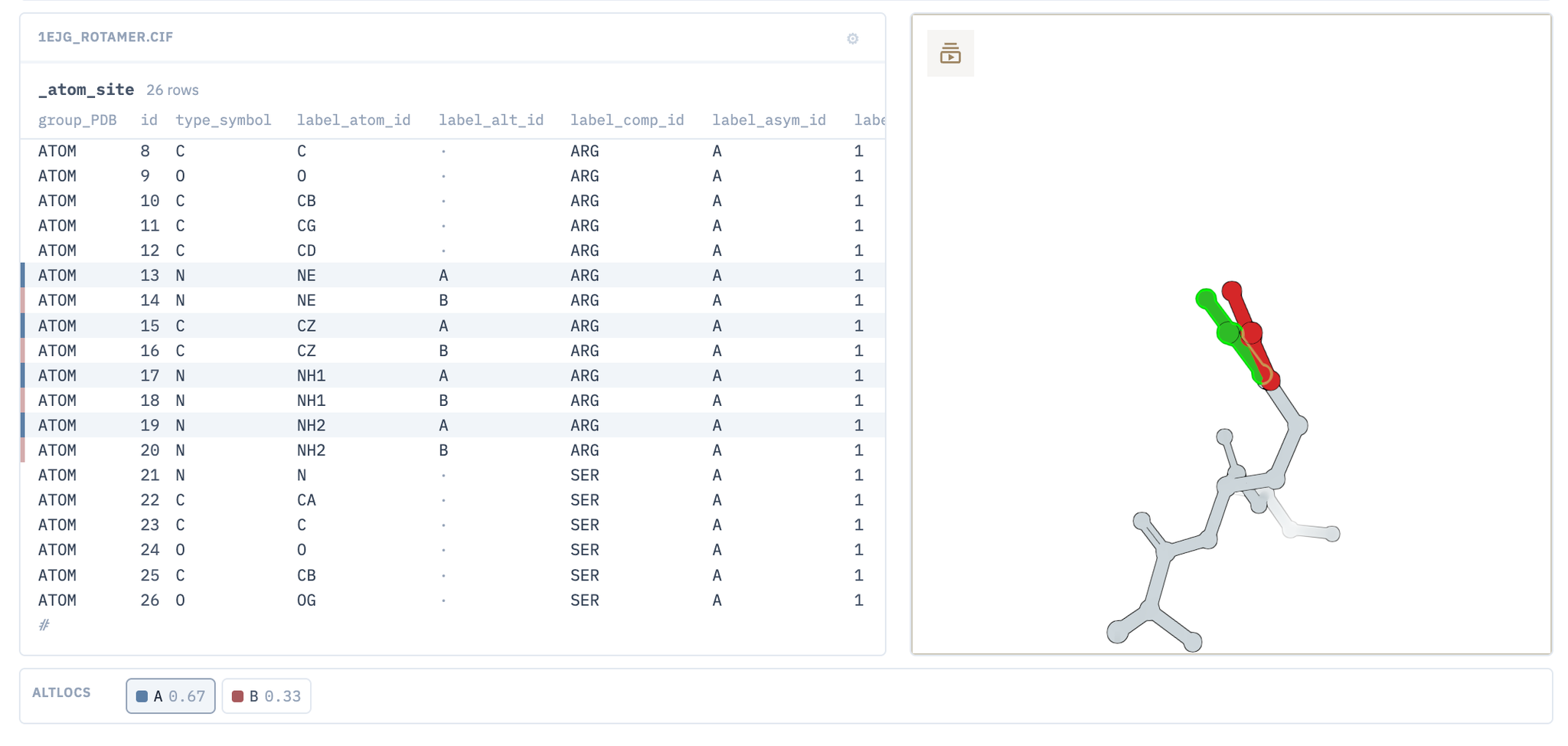
The mmCIF Explorer, a playground for inspecting how heterogeneity is encoded in PDBx/mmCIF files.
Metrics for Ensembles
The metrics attached to models in existing structural databases make it easy to compare structures and judge model trustworthiness. However, these metrics were designed for static structures. We are developing corresponding metrics for ensembles, focused on two questions:
- 1.How can you compare different ensemble models?
- 2.How well does an ensemble model fit the experimental data?