Modeling
Modeling data heterogeneity

Hidden PDB: Unlocking Heterogeneity from Existing Data
Public repositories like the Protein Data Bank already hold an enormous amount of structural biology data. Much of that data carries hidden, unmodeled signal about ensembles. X-ray crystallography and cryo-electron microscopy measure averages over millions of conformations. Most models do not represent that reality. What gets discarded is the dynamic signal. Ensemble models describe the experimental data more accurately. We are developing AI algorithms to capture this hidden data.
We have already released the largest ensemble dataset to date. Read the publication. We are building these methods and releasing the models and algorithms openly to accelerate the field.
sampleworks
Biomolecular structure prediction algorithms are currently trained on single, static structures and fail to accurately predict the ensemble of conformations. However, current models show promise in capturing the underlying distribution of conformations of proteins.
We built sampleworks to speed algorithmic development. It is a platform that integrates structural biology observables, structure predictors, and guidance to improve conformational ensemble modeling.sampleworks is unlocking new data sources for training the next generation of biomolecular structure predictors. Read the first publication.
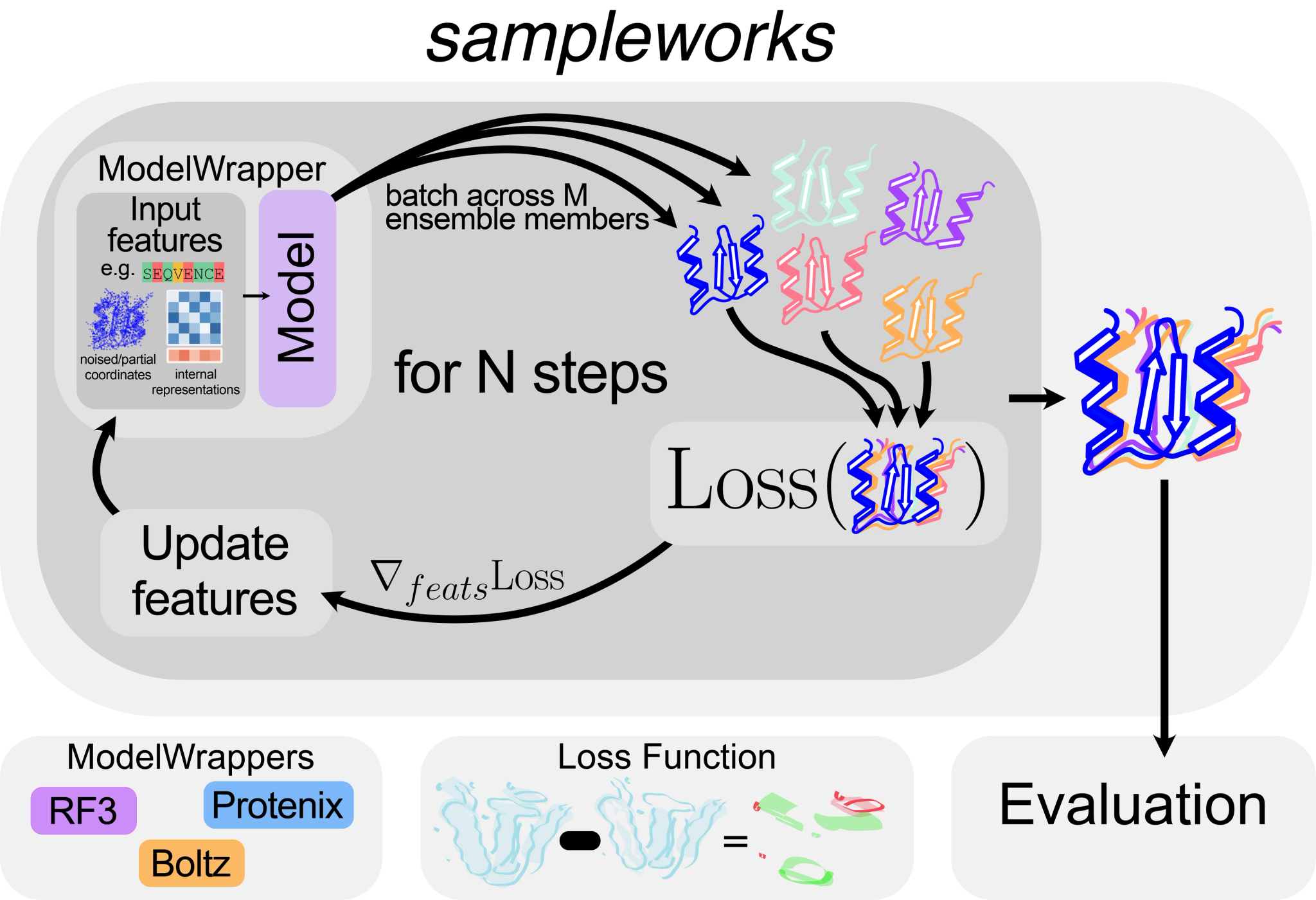
Sampleworks guides a generative structure predictor towards an ensemble that reflects the experimental data.
Integrating Structure Modeling and Prediction
The studies of modeling experimental structures and predicting protein ensembles are converging. Our work is merging these two areas of structural science. By uncovering more data latent in experimental data, we are use this data to directly improving ensemble prediction algorithms.
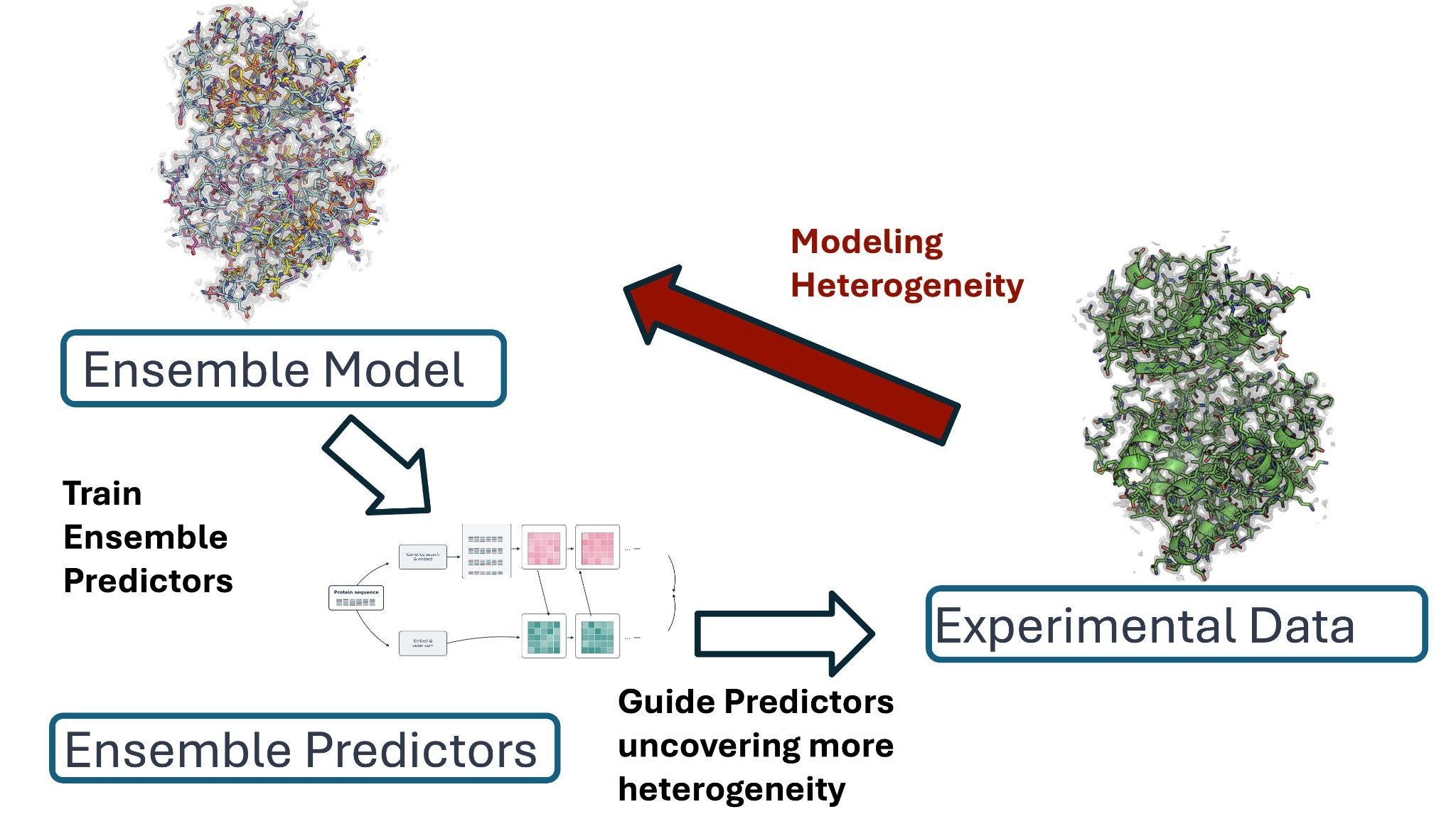
Experimental data and ensemble prediction feed each other: models trained on ensembles guide the predictors, which in turn uncover more heterogeneity in the data.
Predicting and Modeling Water
Ordered water molecules mediate ligand binding, catalysis, and specificity. They are also among the least reliably modeled features in a structure. Because of this, we are very poor at predicting them.
We developed WaterFlow, a state-of-the-art deep learning algorithm for predicting and modeling water in structures. WaterFlow can predict the location of water molecules to identify biologically important waters in models that lack them. This makes water available as a design variable in ligand discovery and protein engineering. Read the publication.