Modeling Blog
Crystal Vibrations in Molecular Dynamics
2 min read
In my last post, I wrote about my goal of using both molecular dynamics (MD) and elastic network models to simulate the motions that occur inside of protein crystals. At the outset, we weren’t sure whether MD models of crystalline supercells would show substantial crystal vibrations or whether they would be dominated by other types of packing disorder. And if there were evident vibrations, would they be interpretable from diffuse intensities calculated from the MD trajectory?
In order to investigate this, I calculated the diffuse intensities from a 1µs trajectory of my 5x5x5 supercell built from P1 lysozyme (Figure 1). I shared it with Steve Meisburger (fellow diffuse/Prism collaborator affiliated with CHESS and the Ando Lab @ Cornell) for processing. He ran a GOODVIBES (GV) analysis on it, and it was able to successfully pick out a subset of halo features from the diffuse map. After fitting a lattice vibration model to the halos, he computed the center of mass (COM) covariances of every lysozyme molecule (such covariances are associated with translational vibrations).
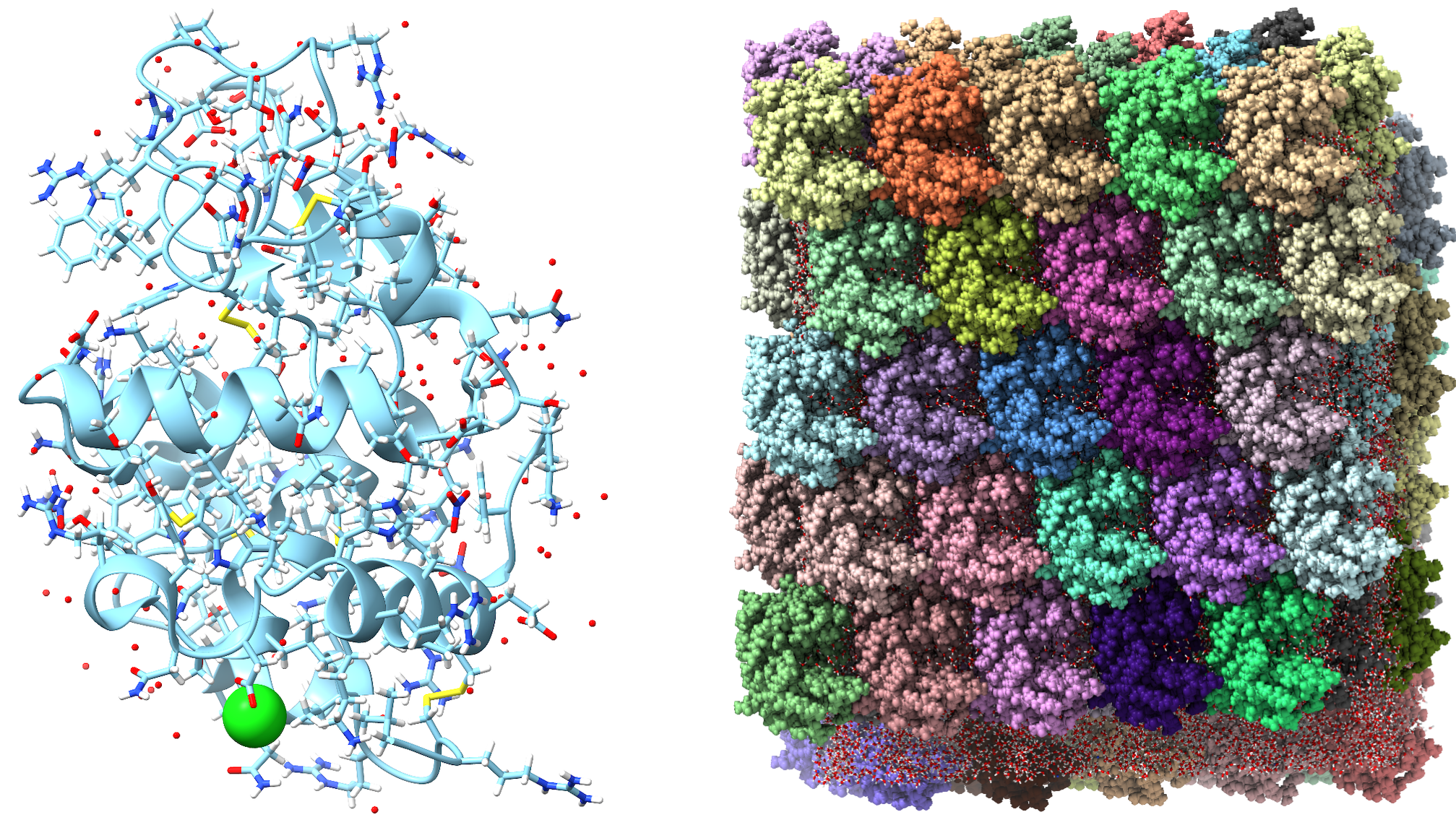
Figure 1: (Left) HEW lysozyme 6O2H structure. (Right) Our solvated and equilibrated 5x5x5 triclinic crystal built from 6O2H. This system contains ~360,000 atoms and was used as the basis for production simulations of unrestrained dynamics.
The results looked reasonable given our experience with other systems. I followed up with calculating the COM covariances directly from the trajectories and compared them to the GV report (Figure 2). There is a remarkable agreement between inter-protein covariances, showing that MD diffuse maps are indeed amenable to GV analysis. The agreement is best at long distances, with only the zero point self-variance term differing substantially --- something we’re actively looking into. The compatibility between GV and MD gives us confidence that we will be able to combine these models to move toward simulations of protein crystals that accurately model both lattice dynamics and internal protein motions. In the future, we want to leverage these analyses to learn how we can subtract out vibrational features arising from lattice dynamics to focus on the diffuse scattering caused by motions internal to the unit cell.

Figure 2: Total covariances of rigid-body translations in the 5x5x5 triclinic system. The plot compares covariances estimated by GOODVIBES from the MD-simulated diffuse map and the true MD covariances calculated from the simulation trajectory. The covariance values are averaged over all possible protein pairs for each given displacement vector between two unit cells. Total covariance refers to the trace of each covariance matrix divided by three and the magnitude of each displacement vector is indicated on the x-axis.
Share article: